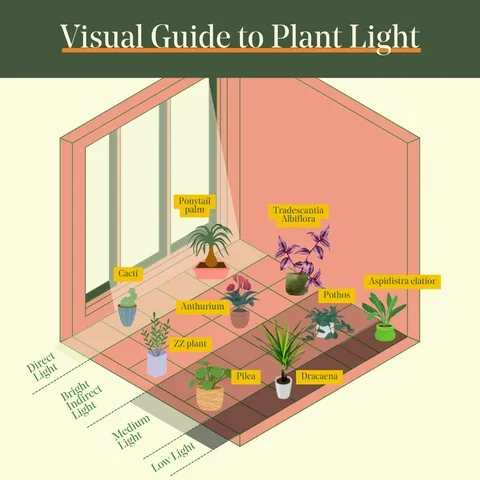
Understanding Light Without Overthinking It
“Bright indirect light.”
If you've owned houseplants for any amount of time, you've probably seen those three words everywhere.
But what does that actually mean inside your house?
You don't need to become a lighting expert to keep houseplants happy. Understanding a few basic concepts will get you surprisingly far.
Windows are your main light source
For most homes, the amount of natural light a plant receives is determined largely by how close it is to a window and what direction that window faces.
Light intensity drops quickly as you move farther into a room.
A plant sitting directly beside a bright window can receive dramatically more usable light than the same plant sitting across the room — even if both locations look bright to you.
Our eyes are extremely good at adjusting to different lighting conditions.
Plants aren't fooled quite as easily.
What is bright indirect light?
Think of bright indirect light as a location that receives lots of natural daylight without being exposed to intense direct sun for long periods.
A spot near a bright window, sometimes filtered by a sheer curtain, is a classic example.
Many popular tropical houseplants thrive under these conditions, including Pothos, Philodendrons, Monsteras, Syngoniums and many Alocasias.
What does “low light” actually mean?
Low-light tolerant does not mean no light.
Every plant needs light.
A low-light plant is simply capable of maintaining itself under lower light conditions than many other houseplants.
ZZ Plants and Snake Plants are famous for tolerating relatively low light, but they'll generally grow more actively when they're provided with brighter appropriate light.
If a corner of your home receives virtually no natural daylight, you'll probably need a grow light if you want to keep a plant there long term.
What about direct sunlight?
Direct sunlight isn't automatically bad.
Some houseplants can handle or even appreciate periods of gentle direct sun, particularly morning sunlight.
The concern is suddenly placing a plant accustomed to greenhouse or indirect conditions into hours of intense sunlight. Leaves can scorch before the plant has time to acclimate.
If you're moving a plant into substantially brighter conditions, introduce the additional light gradually.
Window direction helps
In much of the Northern Hemisphere, a simple starting point is:
North-facing windows: generally softer, lower-intensity light.
East-facing windows: excellent morning light and often very houseplant friendly.
South-facing windows: potentially the brightest exposure throughout the day.
West-facing windows: stronger afternoon and evening sun that can become intense.
Trees, neighboring buildings, roof overhangs, curtains and the distance from the window can dramatically change these conditions.
That's why window direction is a guide rather than a guarantee.
Your plant will tell you a lot
Plants receiving insufficient light may develop:
• Slower growth
• Smaller new leaves
• Longer spaces between leaves
• Growth leaning toward the window
• Reduced variegation in some plants
• Soil that stays wet much longer than expected
Too much intense light can cause:
• Bleached areas
• Crispy or scorched patches
• Faded foliage
• Stress after a sudden move to a brighter location
Pay attention to new growth. It's one of the best indicators of whether your plant likes its location.
Light affects watering, too
This is important.
A plant receiving more light will generally use water faster than the same plant growing in lower light.
That's another reason fixed watering schedules can cause problems.
Move a plant into lower light and its soil may suddenly take much longer to dry. Move it somewhere brighter and you may find yourself checking it for water more frequently.
Light and watering always work together.
When natural light isn't enough
Grow lights are perfectly acceptable.
They're especially useful during dark winters, in rooms with poor window exposure, or when you simply want plants somewhere natural light doesn't reach.
A grow light doesn't need to turn your living room into a greenhouse. Even supplemental lighting can make previously difficult locations much more plant friendly.
Don't overthink it
Start with the care recommendation for your particular plant.
Place it somewhere that seems appropriate.
Then watch how it grows.
If it's producing healthy new foliage and maintaining good color, you're probably doing something right.
Plants don't require perfect conditions.
They require good enough conditions, consistently.
Plants Worth Growing.
Mary Mae Greenhouses